
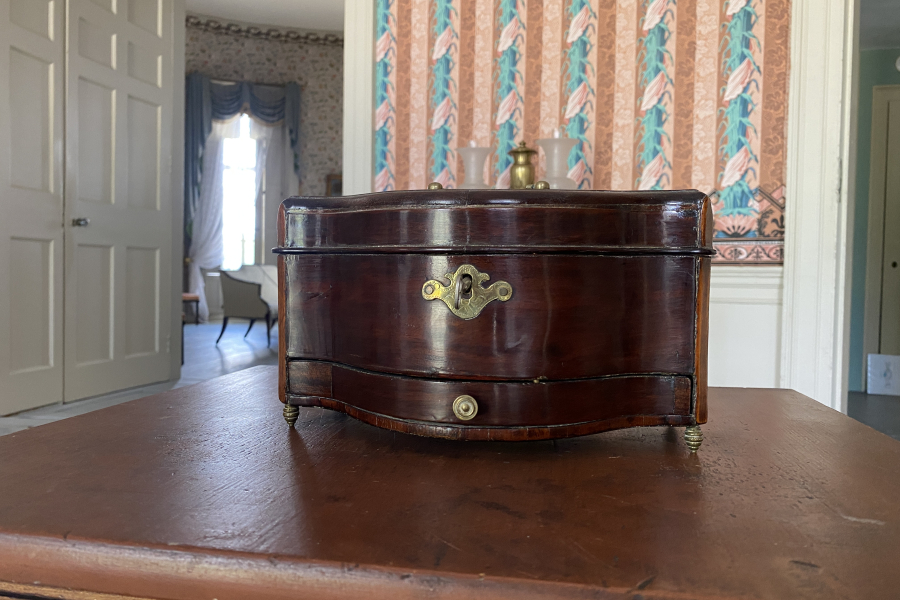
Tea Chest, c.1760-1780
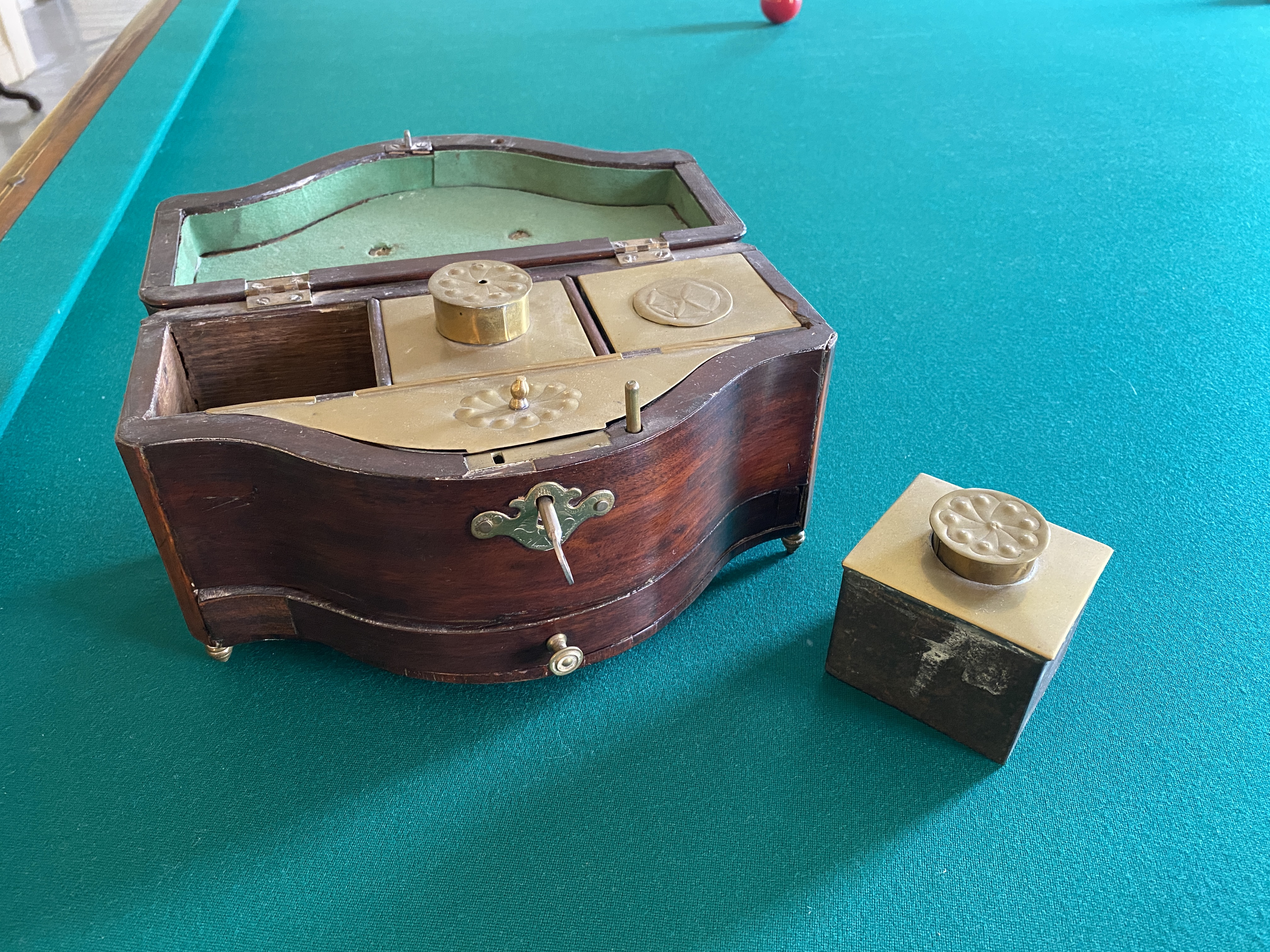
Tea Chest (with tea caddies inside), England, c.1760-1780, Mahogany, mahogany and maple veneers, brass, tin, wool
Written by Connor McElhinney, Collections Specialist
Nowadays, people consider a nice cuppa tea as the stereotypical drink of the British, however, this has not always been the case. Tea has been cultivated and drunk in China for over two thousand years, but it was only introduced in England during the mid-17th century, being first sold in in London in 1658. Catherine of Braganza later going on to popularize it within the English aristocracy after she married King Charles II in 1662.
Having come half-way around the world, from China to Britain on British East India Company ships, tea was incredibly expensive. This made it a commodity worth keeping safe and secure. Therefore, a designated container was needed for its domestic storage, partly to keep it fresh, but also partly to protect it from the hands of pilfering servants. Thus, lockable containers known as tea chests were created, containing small cannisters for green and black tea and a central cannister for sugar.
As the 18th century progressed, these cannisters became known as tea caddies. The term ‘caddy’ deriving from the Malay word ‘kati’: a unit of measurement equivalent to 600 grams. A kati also happened to be the exact amount in a standard 18th century packet of tea. Hence, the word was picked up by the English as ‘catty’ and applied specifically to the Chinese good tea, which later became ‘caddy’ in reference to any container for tea leaves.
During the second half of the 18th century, tea drinking became a far more common domestic affair. However, tea was still considered a luxury. Consequently, tea chests became a status symbol, as well as a sign of good taste. Tea chests and caddies were considered important pieces of furniture in England and were often made to fit in with the rest of the décor in the room. Although most tea chests were constructed from wood, some craftsmen began to utilise a larger variety of materials, including silver, ivory, pewter, tortoiseshell, brass, copper, enamel, and ceramic. Wealthy individuals would hire these craftsmen to create beautiful and ornate chests and caddies, allowing them to keep their tea leaves safe, while also displaying them in a manner that was fitting to their expense.
Interestingly, tea was just as popular in colonial North America as in England, yet the system governing its trade was convoluted from the start. Colonists were legally required to buy tea through Britain, but the British East India Company could not sell directly to them – it had to auction its stock wholesale in England to be resold in America. This arrangement grew increasingly strained by taxation. Tea entering the Dutch Republic went untaxed, while the Company paid 25% on every import into Britain, making smuggled Dutch tea far cheaper by comparison.
To help the British East India Company compete, Parliament passed the Indemnity Act in 1767, lowering domestic tea tax. To offset this loss in government revenue, Parliament simultaneously passed the Townshend Revenue Act, taxing tea, glass, lead, oil, and paper imported into the American colonies. However, due to protests and boycotts, by 1770, every Townshend tax except the one on tea had been repealed. This was hardly a crisis at the time, as roughly 86% of the tea consumed in America came through colonial smugglers like John Hancock and Samuel Adams anyway.
By 1773, due to a number of reasons, the British East India Company was sitting on 17 million pounds of unsold tea and facing financial collapse. So, Parliament passed the Tea Act in 1773, allowing the Company to export tea directly to the colonies for the first time. Importantly, the tea would arrive duty-free, undercutting the smuggled Dutch tea and effectively granting the Company a monopoly. However, colonists were still required to pay the remaining Townshend tax on tea, 3 pence for every pound imported.
Colonists saw the Tea Act for what it really was, i.e., an attempt to make them tacitly accept Parliament’s authority to tax them. Outrage and resistance spread quickly, culminating in Boston on December 16, 1773, when members of the Sons of Liberty boarded three ships in the harbour and dumped 92,000 pounds of tea into the water. The Boston tea Party was, at its core, a protest against taxation without representation – the belief that Parliament had no right to tax people who had no voice in government and became one of the defining events on the road to the American War for Independence in 1775.
Sources:
https://antique-collecting.co.uk/2022/07/28/tea-chests-and-caddies-the-essential-guide/
https://fineart-restoration.co.uk/news/sipping-in-style-tea-caddy-history-and-preservation/
https://www.nps.gov/articles/000/tea-chests.htm
https://newenglishteas.com/en-us/blogs/tea-for-two-1/history-and-evolution-of-the-tea-caddy