
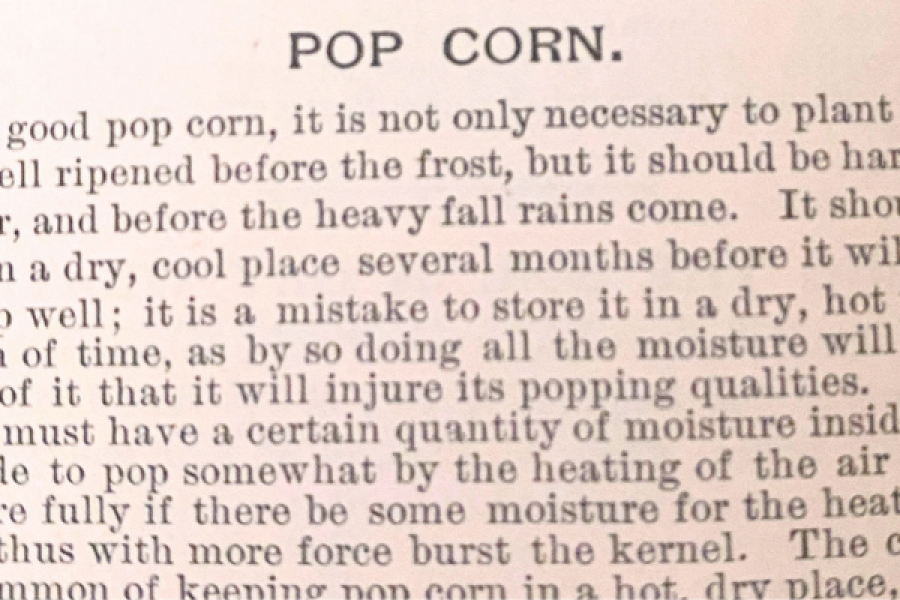
Pop Corn entry from an 1899 Almanac in the collection
Written by Jake Villalta, Summer Waltham Partnership for Youth Cultural Resource Intern
Arguably the US’s first food fad: popcorn goes back 6,700 to 3,000 years ago in the Americas to Indigenous Peruvians. It first entered American popular culture in the 19th century and has since become a popular and iconic snack. Today, its popularity allows movie theaters to charge up to $10 or more for a bucket of popcorn. How did we get here?
While the people of Peru had popcorn, the Indigenous peoples of Massachusetts did not; their diet consisted of flounder, cod, clams, berries, birds, and deer. It was not until about 1,000 years ago that strains of flint corn (Zea mays var. indurata) arrived in southern New England, which is distinctly different from popcorn (Zea mays everta). Flint corn's arrival rapidly modified the diets of locals alongside squash and beans; together they became known as the Three Sisters. Legend has it that Squanto himself taught the Pilgrims to grow popcorn, though in actuality it was simply a strain of flint corn that he introduced to them. It wouldn’t be until the 1820s that records of popcorn first appeared in the eastern United States. Not long after Europeans adopted popcorn, production began to expand across the country. It was sold in wagons in 1840s Boston, consumed as a breakfast cereal, and exploded in popularity in the Midwest after the first commercial popcorn-popping machine was created by Charles Cretors in 1885. However, back in Massachusetts, the humid climate meant that it was a considerably less common crop.
Popcorn contains moisture that, once heated, is trapped by the hull and surpasses boiling temperatures, which gelatinizes the starch inside. Eventually, pressure builds, the hull cracks, the moisture escapes, and the gel expands, creating popcorn. However, kernels require a specific 13% to 14.5% moisture content to effectively pop. In order to reach the correct moisture level, the popcorn kernels ideally must dry naturally on the stalk after a 90 - 120 day frost free summer. Midwestern autumns are dry, while New England autumns are often damp, making popcorn a challenging crop to harvest. Nonetheless, it’s still pictured in this Almanac (1899) in the Gore Place collection, which not only depicts corn on the cover but also provides a guide to growing popcorn during the popcorn craze of the 1890s. Despite growing corn on his farm and having an interest in agricultural advancements, it’s unlikely that Christopher Gore ever tasted popcorn as he died in 1827, a decade or so before popcorn became popular.
Today, you’ve likely tasted popcorn in movie theaters. This trend started in the 1930s, when theaters that sold popcorn were often the ones that generated enough profits to survive the Great Depression. Originally many theaters disliked popcorn because it wasn't “high status” and they believed it distracted from films, especially silent ones. However, as it became more popular and profitable, they began selling it. Popcorn remains one of the most popular theater concessions to this day. While concessions make up about 20% of gross revenues, because theaters make around 85% profit off these sales, concessions account for 46% of theaters’ overall profits. Furthermore, because popcorn kernels expand in volume to over 25 times their original size, it's very cheap to transport and store them as kernels and pop them on site. Ultimately, these factors, plus the vast and ideal growing conditions of the Midwest are why theaters mark buckets of popcorn up to $10 or more. From thousands of years ago in Peru, to cereal, to wagons, to theaters, popcorn has come quite a long way in America, and likely is here to stay.
Sources:
https://www.smithsonianmag.com/smithsonian-institution/ancient-popcorn-unearthed-in-peru-81304339/
https://econlife.com/2026/02/movie-theater-popcorn/
https://plimoth.org/yath/unit-3/nasaump
https://www.sec.state.ma.us/divisions/mhc/archaeology/exhibits/mass-bay.htm
https://www.pbs.org/food/stories/popcorn-history
https://revista.drclas.harvard.edu/peanuts-popcorn-cracker-jack/
https://www.kentohio.gov/training/howdy/
https://yardandgarden.extension.iastate.edu/faq/what-proper-way-harvest-and-store-popcorn
https://www.history.com/articles/a-history-of-popcorn
https://www.smithsonianmag.com/arts-culture/why-do-we-eat-popcorn-at-the-movies-475063/
https://movieweb.com/how-did-popcorn-become-movie-snack/
https://www.smithsonianmag.com/arts-culture/why-do-we-eat-popcorn-at-the-movies-475063/
https://www.gsb.stanford.edu/insights/why-does-movie-popcorn-cost-so-much